New toys
A recent UK price drop meant I've finally been able to get my hands on a pair of Audio-Technica AT4022s - the successor to the AT3032 which has proved very popular amongst wildlife recordists for its low self-noise and affordable price.
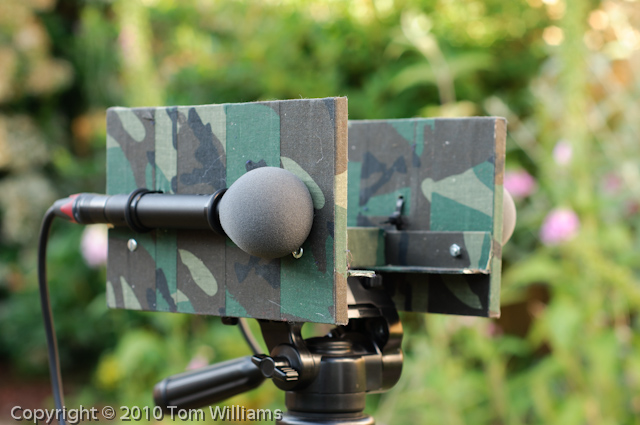
The AT4022 is an omnidirectional microphone, meaning it is equally sensitive to sound from all directions.1 Because of this, an ORTF set-up like I was using with the RØDE NT1As would deliver very little in the way of stereo. Instead I've mounted the microphones in a parallel boundary array, based on the work of Curt Olson and other contributors to the Naturerecordists Yahoo group (photos below).
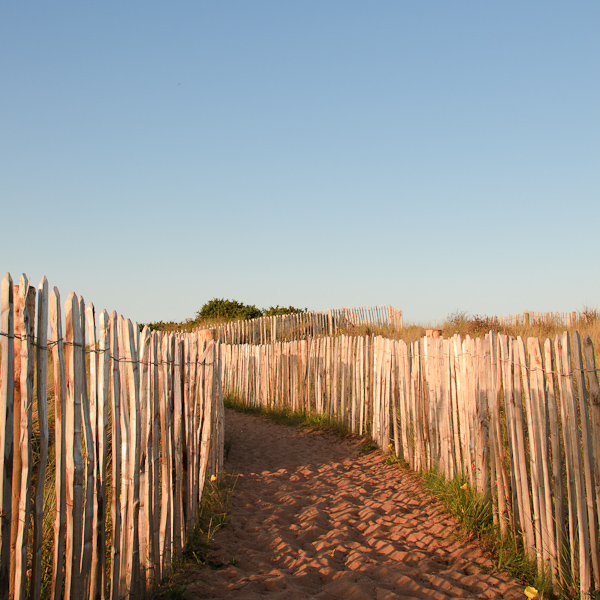
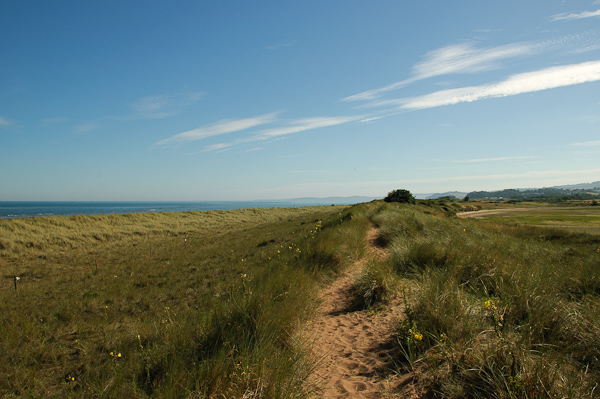
These recordings are from a morning spent testing the new rig on the sand dunes at Dawlish Warren NNR. The microphones are connected to a Tascam HD-P2 recorder, and the only post-processing is a gain boost of around 20dB to save you turning up your speakers!
Whitethroat (Sylvia communis)
Skylark (Alauda arvensis)
Initial thoughts - the self-noise of the microphone is definitely more noticeable that that of the NT1As2 but the recordings have a far more natural feel. With the NT1As I always "knew" I was listening to a recording, whereas with a good set of headphones it's possible to completely lose yourself in the AT4022 recordings and feel like you're back in the field listening to the birds. My guess is this is partly down to the more even frequency response of the new microphones, along with the better stereo field created by the parallel boundary array.
The recordings were made on a fairly breezy morning, and the only protection on the microphones was the simple foam cover provided in the box. Aside from a few particularly strong gusts I had no trouble with wind noise while recording - another advantage of omnidirectional microphones which are typically much less sensitive to wind than cardioids.
Posted from Exmouth, England, United Kingdom.
- Theoretically anyway. In practice the response pattern becomes a little uneven at higher frequencies - see this diagram: http://eu.audio-technica.com/en/resources/e873eb8efe56cafc_at4022_polar.jpg [↩]
- The AT4022 is rated at 13dB(A) self-noise as opposed to the 5dB(A) of the NT1A, one of the quietest consumer microphones available [↩]
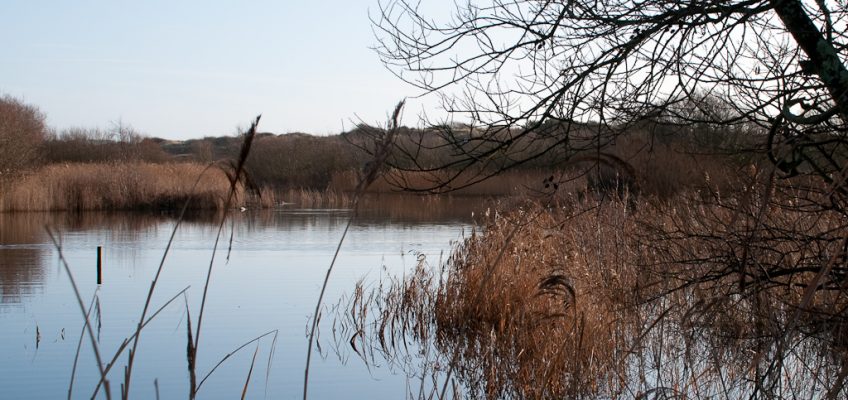
Morning at Dawlish Warren
A few minutes beside the pond at Dawlish Warren, with Canada Goose (Branta canadensis), Mallard (Anas platyrhynchos), Little Grebe (Tachybaptus ruficollis), Coot (Fulica atra) and Willow Warbler (Phylloscopus trochilus) all making an appearance.
Dusk at Dawlish Warren
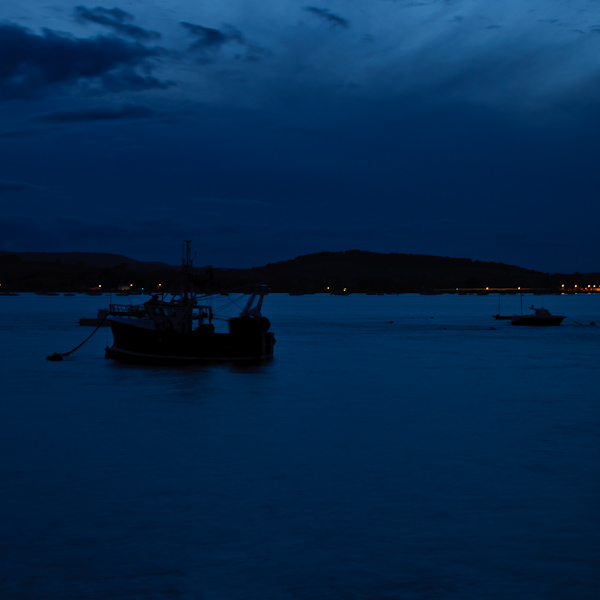
This recording was made at dusk, on the edge of the Bight, a shallow area of tidal water on the inland side of Dawlish Warren NNR. The 23-minute long clip covers a period from just after sunset until twilight - the original was several minutes longer, however I have removed sections where railway/aircraft/road noise became a distraction.
As the recording begins, the sun has just dropped below the horizon, and a Blackbird is still singing in the scrubby bushes on top of the sand dunes. Although the air is perfectly still, recent bad weather has left the sea quite rough, and the pounding of the waves on the far side of the dunes forms a constant bass rumble. As Herring Gulls stream overhead on their way out to sea, small groups of Curlew and Redshank begin to drop into a roosting site about 100m away along the water's edge. Just after the 7 minute mark, one of the Brent Goose flocks that winter on the Exe Estuary flies in and lands in the distance.
As the birds continue to arrive, and the rising tide shrinks the roosting space available, occasional scuffles break out. Eventually, at 12m 39s, something causes most of the roosting birds to take to the air and circle before settling again. Peace returns until 17m 40s, when a Blackbird begins to give an alarm call, almost certainly in response to an approaching hawk. The hawk (from its size probably a Sparrowhawk, although Peregrine seems more likely in that habitat) actually flies past the microphones at 18m 21s, the rush of its wings just audible above the surf. I was sitting on a driftwood log just behind the microphones, and the bird passed by at eye level about 2m away, just a grey ghost in the twilight. Although the birds don't take flight again the presence of the hawk seems to unnerve them, and both the Redshank and Curlew are very vocal for the last few minutes of the recording.
If you're wondering what the quiet sizzling and popping noises are right through the clip, it's not the microphones acting up in the cold, damp air (the aluminium tripod was running with condensation when I finished recording) but the tide creeping in across the mud. By the time I packed up and left the water was only a few inches from the feet of the tripod!
Audio clip: Adobe Flash Player (version 9 or above) is required to play this audio clip. Download the latest version here. You also need to have JavaScript enabled in your browser.
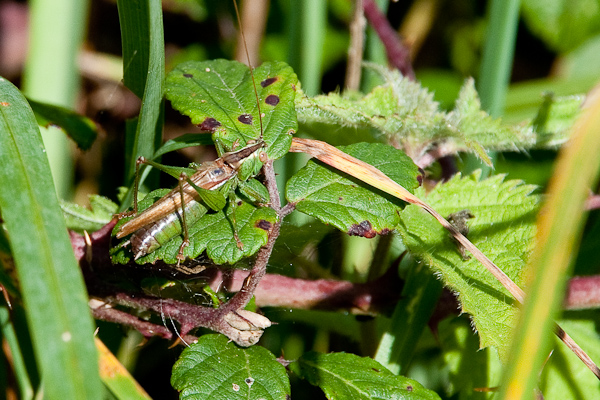
Long-winged Coneheads
I've been hearing these crickets calling since August, but it was only the other day that I managed to get a look at one and actually identify the species.
I can hear the call very clearly, even over background noise like traffic, but all the people I've pointed it out to have had to listen for several minutes before they "tune in" to the sound. I'd be interested to hear how easily people can pick it out when they listen to the recording...
Audio clip: Adobe Flash Player (version 9 or above) is required to play this audio clip. Download the latest version here. You also need to have JavaScript enabled in your browser.
Recorded at Dawlish Warren NNR with an Olympus LS-10, using the built-in microphones with Rycote Mini Windjammers.
Great Green Bush-crickets
These Great Green Bush-crickets (Tettigonia viridissima) were calling in bramble scrub at Dawlish Warren NNR just after sunset on a warm August evening.
They're very hard to track down as there are so many singing at once that it's almost impossible to zero in on one individual. When you do get up close to one the volume of the call is incredible.
Recorded with the built-in microphones on an Olympus LS-10. No post-processing needed, the crickets were loud enough to down out almost all the background noise!
Audio clip: Adobe Flash Player (version 9 or above) is required to play this audio clip. Download the latest version here. You also need to have JavaScript enabled in your browser.
Whitethroat
Recorded on a breezy day at Warren Point in Dawlish Warren NNR. For the first few minutes of the recording the bird is singing in the distance. It then makes a short song flight near the microphone, falls silent for a minute and then sings close by.
Audio clip: Adobe Flash Player (version 9 or above) is required to play this audio clip. Download the latest version here. You also need to have JavaScript enabled in your browser.
Recorded with a Sennheiser K6/ME66 microphone and an Olympus LS-10 recorder. Gain boosted and aircraft noise removed using Cubase LE.
Willow Warbler
A few weeks ago I picked up a Sennheiser ME66/K6 combo at a bargain price on eBay. The ME66 is a short shotgun microphone capsule, which fits onto the K6 power unit. The K6 runs off 48v phantom power or from a single AA battery, meaning the microphone can be used with any of the smaller audio recorders which don't supply phantom power. The microphone makes a nice light-weight alternative for when I don't want to carry around my NT1-A stereo rig. It's mono only of course, but unless you have over £2000 to spend on a Sennheiser MKH30/40 mid-side pair, you're not going to find a low-noise stereo solution that fits into a single Rycote windscreen.
To test the mic out, I took it to our local nature reserve, Dawlish Warren NNR. It was a beautiful Saturday afternoon, and the reserve is immediately behind a popular tourist beach, so most of the recordings came out with a lot of human noise. After walking around for a bit I found this Willow Warbler (Phylloscopus trochilus) singing in a clump of birch trees. You can just hear some quiet conversation from the nearby golf course, and an occasional vehicle, but these are drowned out by the incredibly powerful song of the warbler, which was a good 20m from the microphone. Also audible are Rook (Corvus frugilegus), Blackbird (Turdus merula), Blackcap (Sylvia atricapilla), Blue Tit (Cyanistes caeruleus), Herring Gull (Larus argentatus) and Linnet (Carduelis cannabina).
Audio clip: Adobe Flash Player (version 9 or above) is required to play this audio clip. Download the latest version here. You also need to have JavaScript enabled in your browser.
Dawlish Warren Pond
This was recorded at around 06:45 this morning, after a failed attempt at dawn chorus recording. Possibly the fact that it was the coldest night for several weeks had put the birds off, as there was virtually no song in the woodland surrounding this small pond at Dawlish Warren NNR. At least the waterfowl did their best to make up for it...
Species include: Little Grebe, Mallard, Canada Goose, Herring Gull, Woodpigeon, Blackbird, Chiffchaff, Greenfinch, Magpie and Carrion Crow.
Recorded with a Tascam HD-P2 recorder and two RØDE NT1-A microphones in a custom-built ORTF array with a central barrier. Filtered to remove vehicle noise and boosted by 6dB in post-processing.
Audio clip: Adobe Flash Player (version 9 or above) is required to play this audio clip. Download the latest version here. You also need to have JavaScript enabled in your browser.