New toys
A recent UK price drop meant I've finally been able to get my hands on a pair of Audio-Technica AT4022s - the successor to the AT3032 which has proved very popular amongst wildlife recordists for its low self-noise and affordable price.
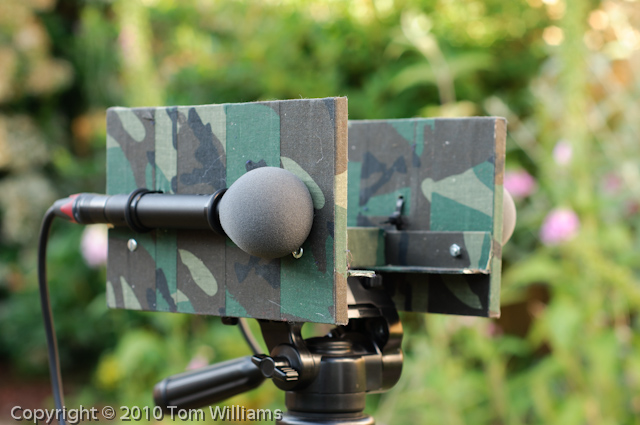
The AT4022 is an omnidirectional microphone, meaning it is equally sensitive to sound from all directions.1 Because of this, an ORTF set-up like I was using with the RØDE NT1As would deliver very little in the way of stereo. Instead I've mounted the microphones in a parallel boundary array, based on the work of Curt Olson and other contributors to the Naturerecordists Yahoo group (photos below).
These recordings are from a morning spent testing the new rig on the sand dunes at Dawlish Warren NNR. The microphones are connected to a Tascam HD-P2 recorder, and the only post-processing is a gain boost of around 20dB to save you turning up your speakers!
Whitethroat (Sylvia communis)
Skylark (Alauda arvensis)
Initial thoughts - the self-noise of the microphone is definitely more noticeable that that of the NT1As2 but the recordings have a far more natural feel. With the NT1As I always "knew" I was listening to a recording, whereas with a good set of headphones it's possible to completely lose yourself in the AT4022 recordings and feel like you're back in the field listening to the birds. My guess is this is partly down to the more even frequency response of the new microphones, along with the better stereo field created by the parallel boundary array.
The recordings were made on a fairly breezy morning, and the only protection on the microphones was the simple foam cover provided in the box. Aside from a few particularly strong gusts I had no trouble with wind noise while recording - another advantage of omnidirectional microphones which are typically much less sensitive to wind than cardioids.
Posted from Exmouth, England, United Kingdom.
- Theoretically anyway. In practice the response pattern becomes a little uneven at higher frequencies - see this diagram: http://eu.audio-technica.com/en/resources/e873eb8efe56cafc_at4022_polar.jpg [↩]
- The AT4022 is rated at 13dB(A) self-noise as opposed to the 5dB(A) of the NT1A, one of the quietest consumer microphones available [↩]
Whitethroat
Recorded on a breezy day at Warren Point in Dawlish Warren NNR. For the first few minutes of the recording the bird is singing in the distance. It then makes a short song flight near the microphone, falls silent for a minute and then sings close by.
Audio clip: Adobe Flash Player (version 9 or above) is required to play this audio clip. Download the latest version here. You also need to have JavaScript enabled in your browser.
Recorded with a Sennheiser K6/ME66 microphone and an Olympus LS-10 recorder. Gain boosted and aircraft noise removed using Cubase LE.